From the first line on a drawing to demolition, reuse, and adaptation, sustainable architecture considers the complete life cycle of a building.
Architecture is often measured by what we see.
The façade. The proportions. The materials. The light. The experience of a space.
But a building has a life that extends far beyond the moment it is completed.
Before the first foundation is laid, decisions have already been made about where materials come from, how much energy a building will consume, how it will respond to its climate, how easily its spaces can adapt, and how long its components might remain useful.
So perhaps the more important question is not:
“What are we designing?”
But:
“What kind of life are we designing for the building?”
The First Line Is Only the Beginning

A drawing is often treated as the beginning of a building.
In reality, it is the beginning of a chain of decisions.
The orientation of a building can influence heat gain and daylight for decades. The structural grid can determine whether spaces can be reconfigured. The choice of materials can affect maintenance, replacement and eventual disposal. The way systems are integrated can determine whether they can be repaired—or must be replaced entirely.
Every design decision has a timeline attached to it.
Good architecture considers not only how a building performs today, but how it might perform 10, 20, 50 or even 100 years from now.
Designing for Change

Buildings are rarely used exactly as originally imagined.
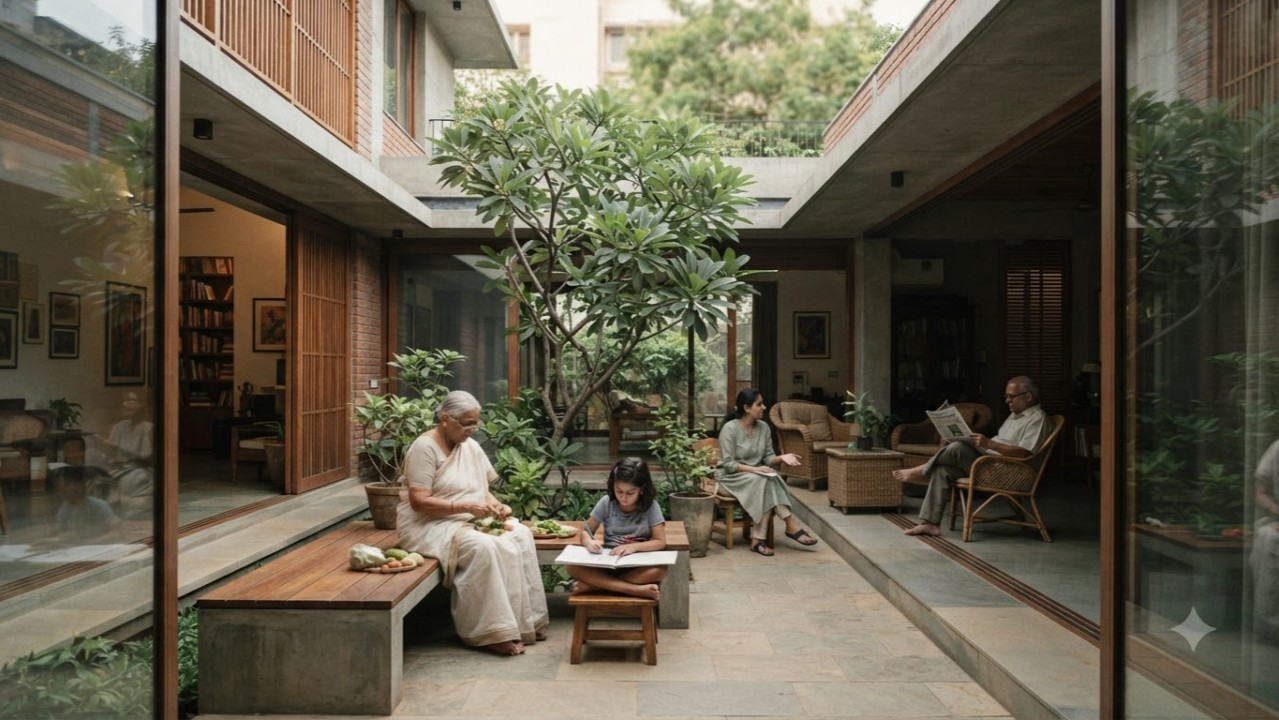
Families grow. Businesses evolve. Technology changes. Climate conditions shift. Neighbourhoods transform.
A space designed for one purpose today may need to serve an entirely different purpose tomorrow.
This makes adaptability an important part of sustainable design.
A building that can be modified rather than demolished can preserve something far more valuable than its physical structure:
the resources, energy and carbon already invested in it.
Instead of asking, “How do we make this building last?”
Perhaps we should also ask:
“How do we make this building capable of changing?”
The Second Life of Materials

Eventually, every building reaches a point where something needs to be replaced.
But replacement does not necessarily have to mean waste.
Materials can be designed, selected and assembled with their next use in mind.
Components that can be dismantled, repaired, reused or recycled create a very different relationship between architecture and resources.
A wall does not have to become debris.
A façade does not have to become waste.
A structural component does not necessarily have to end its life when the building does.
This is where the idea of a circular building becomes powerful—not as a trend, but as a shift in how we think about ownership, materials and time.
Designing Beyond Demolition

Demolition is usually treated as the end of a building.
But perhaps it should be considered another design stage.
What happens to the materials? What can be recovered? What can be reused? What can be transformed? What knowledge can be carried forward?
The most sustainable building may not always be the newest one.
Sometimes, it is the building that can be adapted instead of replaced.
Sometimes, it is the material that can be reused instead of discarded.
And sometimes, the most responsible design decision is to rethink whether demolition is necessary at all.
Architecture Has a Memory

Every building contains embodied resources.
Energy was used to extract its materials. Fuel was consumed to transport them. Labour was invested in assembling them. Carbon was emitted throughout the process.
When we demolish a building, we are not simply removing walls and slabs.
We are potentially discarding decades of embedded energy, resources and human effort.
Designing for longevity means respecting that investment.
It means thinking of architecture not as a finished object, but as a living system with multiple chapters.
From Buildings to Life Cycles

Perhaps the future of sustainable architecture will not be defined simply by how efficiently we construct buildings.
It will be defined by how intelligently we allow them to live.
Design. Build. Occupy. Adapt. Repair. Reuse. Transform. And, only when necessary, dismantle.
The first line on a drawing should therefore consider the last stage of the building’s life.
Because architecture does not truly end when construction is complete.
It continues through every person who occupies the space, every adaptation it undergoes, every material that is reused, and every possibility that remains after its original purpose has changed.
The question for architects is no longer only:
“What should this building become?”
It is also:
“What could this building become next?”
That is where designing for sustainability moves beyond efficiency—and begins to become a way of designing for time itself.